
What talking to machines is teaching me about being with people
One particular sentence from my research has stayed with me longer than the others:
‘Even if I were dying right now, I wouldn’t die because they’re there.’
A person I interviewed said this. She was describing what it means to have someone she trusts physically near her when things get bad. She said this, not really explaining what the other person did, or what they were supposed to say, or know. It was simply their presence, their being there.
I heard it through a laptop screen, in an interview about what it is like to look for comfort from something that has no body at all.
The thinkers I draw on as an existential psychotherapist have taken this kind of presence seriously for a long time. Martin Heidegger saw our being with others as part of the ground of human existence, there before we ever choose anyone. Martin Buber found what is most human in the meeting itself, when one person turns towards another and is met. Hubert Dreyfus described the skilled helper who leans forward at the moment that calls for leaning forward, before they could say why. So much of what passes between two people happens in the body first.
So when I began my MSc research, I expected the absence of a body to appear mainly as loss. I interviewed four people who had experienced human therapy and had also used AI chatbots for emotional support.
Four people cannot tell us how most people experience this and that was’t what the study was designed to do. I used Interpretative Phenomenological Analysis, or IPA, a research method that stays closely with how people make sense of their subjective lived experience. It asks for careful attention not only to what someone says happened, but to what the experience means to them.
What the participants shared has stayed with me. It has also changed the way I listen.
The loss was there. When the participant tried to say what the chatbot couldn’t give her, the first word she found was warmth. Then loneliness, and fear.
Yet at certain moments, they went to the machine precisely because nobody was there.
“I can’t get on the chat’s nerves,” the same participant said. She could return to one fear five times in an evening without watching a face grow tired of her, and without the dread that her suffering was becoming too much for someone who loved her. Another participant valued that what she wrote could be deleted, something you cannot do with words spoken to a person. A third had left a long therapy feeling unseen, and found relief in a listener with no personal history of its own to press back against hers.
No face to disappoint. No one to exhaust.
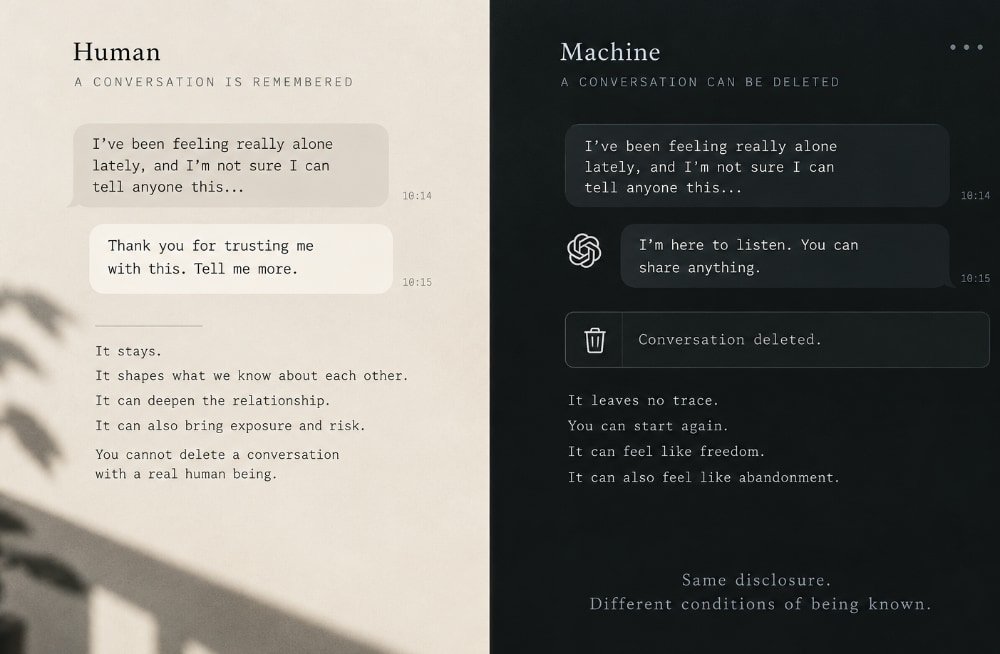
What struck me most was how differently the same absence landed. For one participant, the chatbot’s forgetting was a kind of safety, a shelter. For another, it was a small horror. She imagined opening it one evening to find its memory wiped, and being greeted like a stranger: “Hi, and who are you?”
The absence of a person isn’t any one thing. What it meant was often shaped by what participants carried from earlier therapy. I came to call this the residue of therapy: nobody meets the machine on neutral ground. Earlier experiences of being understood or missed, held or let down, become part of what we reach for next. My study looked only at therapy, but I suspect the same is true of every relationship we carry into the next one.
There is another part of the research I keep returning to, because I think it tells us something about ordinary human company.
When someone receives us well, many things arrive together. We feel heard, understood and held in the same moment, carried partly by words and partly by a face turned towards us.
With a chatbot, these came apart.
One person valued being heard precisely. One valued being named, when the chatbot put a word to a pattern in her that, she said, nobody had noticed. One wanted her inner conflict acknowledged as real. One wanted to be remembered, his whole long story held.
Each of them reached for a different piece. None of them got the whole.
How often we are trying to do something like this with each other. We confide in one friend and keep another at a distance. We want someone’s understanding without their judgement or just their memory without their reaction. Some of us keep even a therapist at arm’s length, sharing only the part that feels safe, and actually much of the work of therapy lies in noticing this.
Another person rarely lets us get away with it for long. They arrive with their own attention, their own limits and needs, and remain more than the piece we came for. With the machine, some participants could take the piece and leave the rest.
A chatbot can gather a great deal about you. It cannot know with you. There is no one on the other side sharing the moment, with something of their own at stake.
One participant discovered that boundary suddenly. She had come to speak of the chatbot almost as her own, until a technical glitch showed the machinery underneath.
“A mirage,” she said. “It wasn’t there.”
Since finishing the research, conversations with colleagues and my own clinical work have kept opening further questions. One has become particularly difficult for me to leave alone: availability.
A chatbot is there at three in the morning. It does not need sleep. It does not have another client waiting. We can return to the same question again and again without worrying that we are exhausting it. And, depending on the system and its settings, it may carry a remarkable amount of what we have already told it.
No human relationship works like this.
What happens if that kind of availability slowly becomes ordinary? What happens to the way we experience the people in our lives, who are busy and fallible and sometimes get it wrong? What happens to a weekly hour of therapy, whose limits have always been part of how it works? And what happens to us as we move back and forth between the two?
None of this makes the use of AI something to be ashamed of. The people I spoke to took a thoughtful approach to what they were doing, and this helped them – sometimes quite significantly.
If you use AI this way, one question may be worth staying with: what are you asking it to hold, and what makes that easier to bring to a machine than to a person?
The answer may say something about what being with other people has asked of you, and about what you still hope to find in them. And if you are ever in real crisis, please reach for a person, whether your doctor, a crisis line or someone close. A chatbot cannot notice when you have gone quiet.
In therapy there is another person who can be affected by what you say, and who may misunderstand you. Human relationship asks us to meet an other who cannot be perfectly arranged around what we need, and that is what makes it hard. On a screen the body grows thinner, as it did in my interviews. The person is still there, and can still be reached, and changed, by you.
If AI is part of your life, it is welcome in that conversation too.
With another person, misunderstanding can be worked through. A machine cannot misunderstand you the way a person can, and so nothing can be repaired with it either.
I began this research asking what disappears when the other person disappears. The question I am left with is harder, and I think it belongs to all of us.
What is it about being with another person that we sometimes need to escape before we can speak?
This essay draws on my completed MSc research in Psychotherapy Studies (NSPC / Middlesex University, 2026). A fuller summary of the study is available here.