What Courage Actually Asks
We celebrate people who push through. But what if the braver thing is to stop?
I was at one of the largest trade fairs in my industry, a global event held once every three years in Frankfurt. It is feels like a World Cup everyone who matters in that industry comes here. For such gathering you are preparing many months in advance. I knew how to be there. I knew how to work the stand, read a conversation, close a deal. But somewhere between my umpteenth coffee and the ritual handshake, I noticed I was performing something I could no longer feel from the inside.
I didn’t leave business when I decided to train as an existential psychotherapist. I still work in both fields. That may not fit the familiar picture of a courageous career change — a decisive break, a leap into the unknown. But I’m not sure courage should be measured by how much we abandon.
I studied psychology before getting into business, and its questions, “How do people make sense of their lives and what do they do when meaning runs thin,” never quite left me. They’d trailed me for over 20 years in sales, deals, company building, all under the guise of other issues: a negotiation I could never resolve, an employee I always dragged my feet on, a lack of focus I excused as an issue of the market.
At some point I began training as a therapist and frankly, it felt less like a leap and more like catching up with something that had been alongside me for a long time.
Too good at pushing through
We tend to recognise courage in what people do and we admire those who push through fear, who hold their ground, who take risk, who exceed what is expected. There is real courage in that, and many of the people I work with are very good at it — business owners and founders, yes, but also the parent who has held a household together through a long illness, the person everyone else leans on and who has never once been allowed to be the one who falters. The pressure differs from one life to the next; what sits underneath it rarely does.
Some of them are too good at it.
This is a theme that comes up in my ears every week. Someone has been moving fast and making decisions and executing decisions and pushing through one decision after another and it is closer to noise than to energy. They say it’s discipline, or drive. When I ask what would happen if they would stop, the room changes. The danger is to cease running; if they would not be able to run, they would hear whatever they have been running away from.
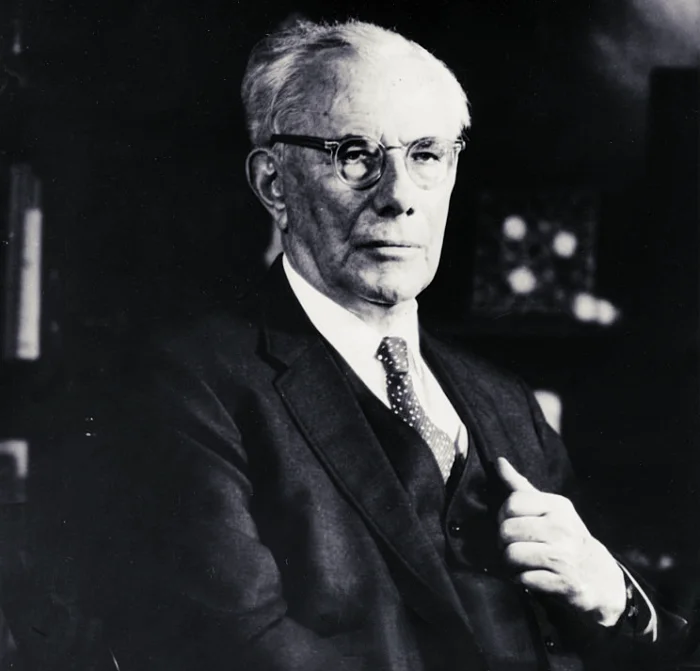
In The Courage to Be, published in 1952, the theologian and philosopher Paul Tillich describes courage as self-affirmation “in spite of”: in spite of doubt and guilt, and in spite of the knowledge that we will die. He was building on older ground. Earlier Heidegger had argued that anxiety concerns our existence as a whole, which is why we can never point to the thing that causes it and take it away. Søren Kierkegaard wrote, a hundred years before, that ‘if you can be anxious in the right way, you have learned the most important thing’. Anxiety for him was the dizziness of freedom – fear of peering into the void of one’s own life, with its infinite amount of dangers that cannot be calculated.
None of the three treated anxiety as the enemy of courage. For each of them, it was closer to the material courage has to work with.
That kind of unease does not fit on a risk register. It surfaces at three in the morning and asks questions no spreadsheet column can hold: what is all this for, and am I still choosing it?
When courage hardens
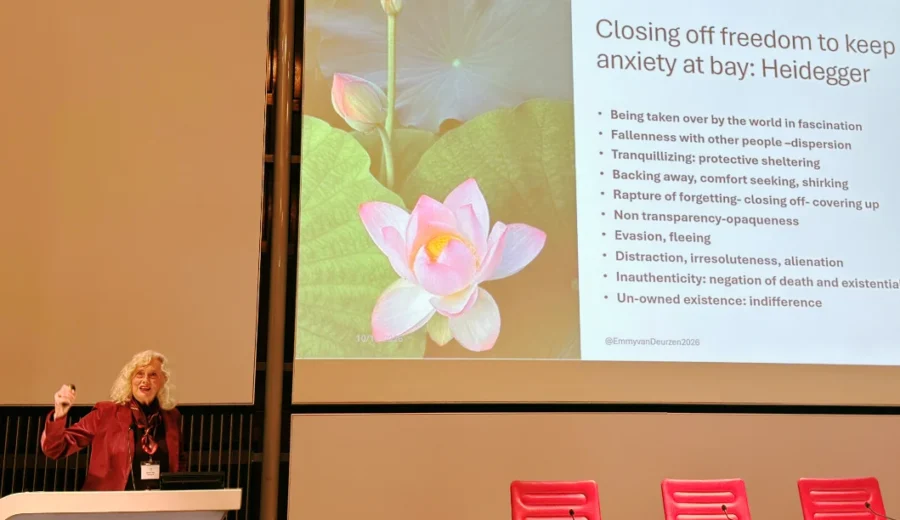
At the NSPC conference in London this October — thirty years of the school Emmy van Deurzen co-founded, and where I trained — she where traced courage through existential philosophy, and she made one observation I have been turning over since. Courage can harden. Determination becomes recklessness. Perseverance becomes the inability ever to let go, and what looked admirable can turn out to be a person’s increasing difficulty in imagining any other way of living.
I see this often in people who build companies. The identity fuses with the work, with being the founder, the leader, the one who holds everything together, until commitment and the fear of what would be left without it become impossible to tell apart. The situation stopped demanding it long ago. They keep pushing because they have forgotten how to do anything else.
Saying no
Which brings me to something I have been sitting with: that courage sometimes means not acting.
I don’t mean passivity or avoidance. I mean seeing how much effort can go into acting against our own values, carrying on down a path we no longer believe in, or forcing ourselves into a shape that no longer fits, and how little of that effort is courage.
I was uneasy when I left a potential merger, although it had been a financially good idea and it had been approved by those around me. The question was, would I still be able to identify myself as free and invulnerable in the company becoming? At the time, it was a failure to be bold to say no. It was one of the more bold things I have done, I’d say.
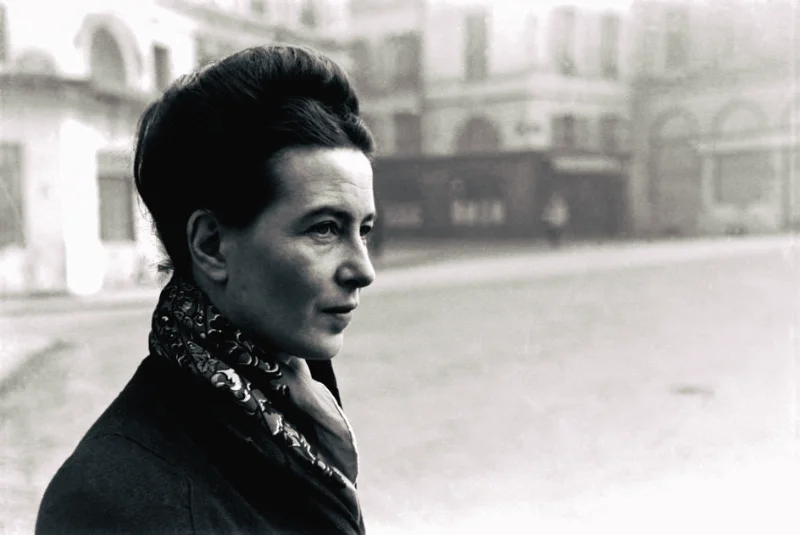
But courage exercised alone is only half the picture. Simone de Beauvoir said that our freedom is connected to the freedom of other people. We live with people whose lives and opportunities are affected by our choices. But if we change direction, even if it’s for a good reason, it will have an effect on the people who depend on us, who have built something with us, and who trusted the kind of life we had together. All of this is not an excuse for not changing, and it’s all a condition where our freedom must exist.
It’s a shape that I’ve been coming back to with Van Deurzen’s four dimensional model. We experience the physical, the social, the personal and the spiritual, and these dimensions do not often go in the same direction.
For instance, making a decision that guarantees material stability could eventually compromise one’s identity and feeling of self-worth. Or something that feels significant to us could be problematic to others. Acknowledging these contradictions and taking responsibility for how we address them is what it means to be courageous.It also means resisting the urge to prioritise what appears to be more crucial and vital and refraining from using responsibility as an excuse for inaction.
I am therefore interested in what is contained in the statement made by the person seated across from me when they say they only need to push through. Reasons tend to be the part that has been rehearsed enough and is polished due to its frequent delivery. Inquiry into the process of pushing, its inner aspects, and what he expects to hear once he stops can reveal some additional information.
Sometimes that opens toward a decision they have been circling. Sometimes it opens something else: permission to reconsider, to let a familiar identity loosen its grip, to find that the courageous step may not be a step forward at all.
I came away from the conference thinking less about courage as some exceptional quality and more about the ordinary, continuing work of examining how we live. We cannot know in advance whether a decision will turn out to be right. We cannot hold every possibility open, or protect everyone from the consequences of what we choose.
But we can keep asking what we are taking responsibility for, in choosing to act and in choosing not to.
If that question is working on you, I would be glad to hear from you.