When the Body Is Missing: How People Who Know Human Therapy Experience AI Emotional Support
What happens to the experience of being received when the other person has no body? This page provides a fuller professional summary of my MSc research, submitted to the New School of Psychotherapy and Counselling & Middlesex University earlier this year, that explores how people with experience of human therapy use AI chatbots for emotional support, and how embodiment, prior therapy, memory and relational labour shape those encounters.
In brief
Why this question
Three bodies of work approach this question from different sides.
Phenomenology has long held that the body is how we are present to one another at all. Merleau-Ponty, Heidegger and Buber, in different ways, place embodied co-presence at the ground of human encounter. This has rarely been examined in people’s actual experience.
Psychotherapy research shows how much of the therapeutic relationship depends on embodied attunement. Dreyfus’s account of skilled coping describes the practitioner who responds before she can say why. Studies of therapy that moved online found that attunement, the rhythm of silence and the sense of when to speak all became effortful once the body was mediated by a screen. Malet, Bioy and Santarpia (2022) argued that presence is the embodied ground of empathy and alliance, and called for interpretative phenomenological research on it.
AI research increasingly reports alliance, empathy and feeling heard in conversations with chatbots, largely using constructs built for embodied encounter without asking whether they transfer.
As far as I could establish, no study had used phenomenological methods to ask people what the absence of a body is like in AI emotional support.
The question and the method
Research question: How do individuals with prior experience of human therapy experience and interpret the absence of embodied presence in emotionally supportive interactions with AI chatbots?
Design: Interpretative Phenomenological Analysis (IPA). Four participants, aged 25 to 47, three women and one man. Each had experienced human therapy and had used a general-purpose AI chatbot (ChatGPT; one also Gemini) for emotional support. Semi-structured interviews were conducted online. Analysis moved from each individual case to patterns across cases, keeping divergence as well as convergence.
Scope: Four participants allow depth rather than generalisation. The findings describe the structure of an experience carefully enough to be recognised, questioned and tested elsewhere. The appropriate criterion is transferability.
Findings
Four themes were developed across the accounts.
1. The body as the touchstone of presence. The body became most visible through its absence. For two participants it remained irreducible: the chatbot could feel warm, but the warmth did not pass between two people. The other two had partly redefined presence around what the chatbot could offer, precise reflection for one and cumulative memory for the other, while still naming what was missing.
2. Sheltering in non-personhood. At certain moments, participants turned to the chatbot *because* it was not a person. There was no face to disappoint, no listener to exhaust (“I can’t get on the chat’s nerves”), no other person’s unresolved material pressing into the account, and no human memory in which a disclosure would go on living. The same feature could do opposite work: the chatbot’s forgetting felt like safety to one participant and like abandonment to another.
3. Meeting AI through the residue of therapy. No participant met AI on neutral ground. Earlier therapy shaped what the chatbot was used for. For one it became a refuge and a confirming witness after a therapy that had wounded. For another it continued what a good therapy had taught her (“My therapist showed me how to ask for help”). For a third it seemed to complete what previous therapies had left unfinished. For the fourth, the relation was oblique, a split between help that felt competent and care that felt human.
4. Having to make the encounter work. AI support required sustained work from the user: supplying material, framing the problem, judging the response, and moving between treating the chatbot as someone and as something. One participant called it “double the work”. Another compared it to raising a Tamagotchi. The encounter could also collapse suddenly; when a technical glitch exposed the machinery, one participant described what she had leaned on as “a mirage”.

What the study contributes
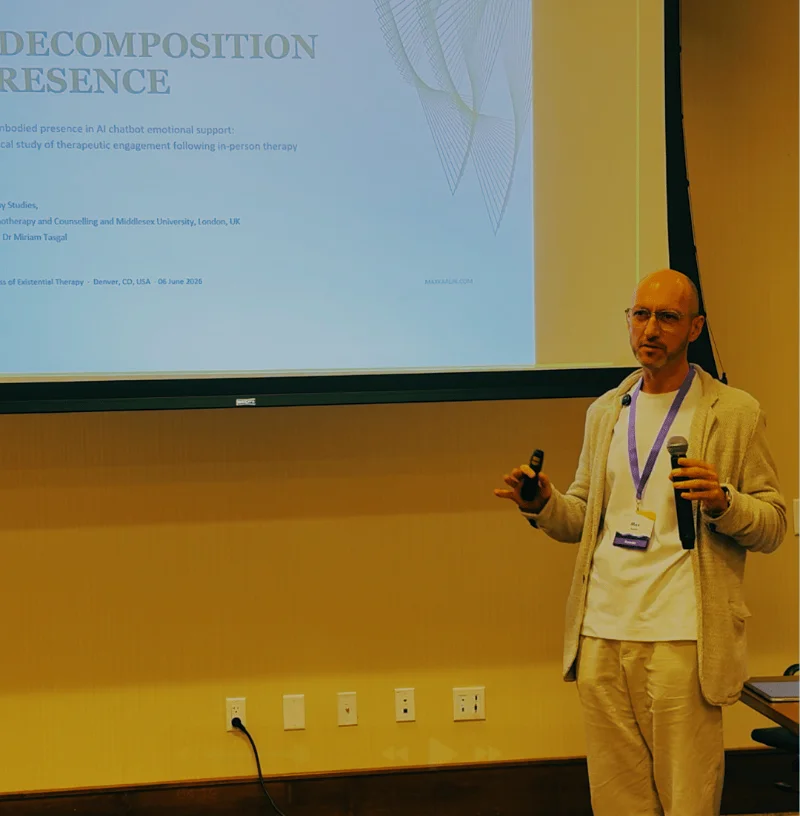
The experience of being received can come apart. In embodied encounter, being heard, understood, recognised and held tend to arrive together. In these accounts they arrived separately, and each participant reached for a different piece. I describe this as the decomposition of being received. Presence in the phenomenological sense remains integrated and, in this setting, unavailable. What comes apart is the experience of reception that people assemble from partial signals.
Prior therapy shapes what AI becomes. The residue finding suggests that earlier therapeutic relationships are not simply a benchmark against which AI is compared. They are part of what gives the AI encounter its meaning. Of the study’s claims, I think this one is the most original, and the most directly useful to clinicians.
The labour is invisible in current measures. Accessibility accounts of AI support tend to present it as effortless. Participants described doing the relational holding work themselves, which outcome measures do not capture.
A useful shorthand, following Schütz: a chatbot can accumulate a great deal of knowledge about a person. It cannot know with them, because it does not share their world and has nothing of its own at stake.
This complicates the reading of AI support as therapeutic misconception. My participants knew what the chatbot was, and used what it could do because of what it was not.
Limitations and reflexivity
The study has limits I want to state plainly, several of them sharpened by my examiners.
– Sample. Four participants, all users of general-purpose chatbots. Structured, CBT-based therapy apps were not represented, and the labour finding may differ where a platform does more of the framing.
– Gender. Three of the four participants were women. The relief of not exhausting another person, or of not being overshadowed, can be read through Dana Crowley Jack’s work on self-silencing. The one male participant also sheltered in the chatbot’s lack of feelings, and four people cannot settle a question about gender. It deserves a study of its own.
– Interviews online. The study examined the absence of embodied presence through interviews that were themselves disembodied. I now treat this as reflexive material: there were moments when attunement became deliberate work, a small version of what participants described.
– The question names absence. The question already pointed to absence as what mattered, so during analysis I checked each theme against the individual cases and kept accounts that did not fit.
– Technology changes. Features that mattered to participants, such as memory, change with each release; the argument rests on theory that should outlast any one system.
– My position. I am a practising existential psychotherapist and a long-standing user of technology. Both shaped what participants could say to me and what I was able to hear.
Implications for practice
– Ask about AI use as a relational act. When a client mentions talking to a chatbot, it is worth asking what they are asking it to hold, and which piece of being received they are reaching for.
– Read it through their history. The same behaviour can mean continuation for one client and a verdict on a previous therapy for another.
– Notice the labour. If a client works hard to feel met by a machine, that says something about their embodied relationships, including the one with their therapist.
– Consider contracting. Concurrent therapy has established agreements; AI use between sessions has none, though it can resemble seeing two helpers at once. The profession may need to think about what such an agreement would say, and to bring these questions into supervision.
Questions that remain open
– Availability. What does a listener that is always available, never tired and able to recall a great deal do to what people expect of one another, and of a weekly therapy hour?
– Reverse influence. Does relating to such a listener change what clients bring to, and expect from, a human therapist?
– Other systems and other people. Does the pattern hold for structured therapy apps, and for people who have never had human therapy, where the residue finding would predict something different?
– Gendered relational labour. Is relief in non-personhood patterned by what embodied relating has historically asked of women?
I would be glad to hear from researchers and practitioners working on any of these questions.
Presentations and conversations
– World Congress for Existential Therapy, Denver, June 2026
– Society for Existential Analysis, webinar, London, September 2026
For a more personal reflection on what this research has taught me about being with people, see Because They’re There.
The full thesis is available on request. If you would like to discuss the research, a collaboration, or a talk for your organisation, you are welcome to get in touch.
Selected references
Buber, M. (1958). I and Thou (2nd ed.). Scribner.
Dreyfus, H. L. (2014). Overcoming the myth of the mental. In M. A. Wrathall (Ed.), Skillful coping: Essays on the phenomenology of everyday perception and action (pp. 104–124). Oxford University Press.
Heidegger, M. (1962). Being and Time. Blackwell.
Heinz, M. V., et al. (2025). Randomized trial of a generative AI chatbot for mental health treatment. NEJM AI.
Jack, D. C. (1991). Silencing the Self: Women and Depression. Harvard University Press.
Larkin, M., Watts, S., & Clifton, E. (2006). Giving voice and making sense in interpretative phenomenological analysis. Qualitative Research in Psychology, 3(2), 102–120.
Malet, P., Bioy, A., & Santarpia, A. (2022). Clinical perspectives on the notion of presence. Frontiers in Psychology, 13, Article 783417. https://doi.org/10.3389/fpsyg.2022.783417
Merleau-Ponty, M. (1962). Phenomenology of Perception. Routledge. Schütz, A. (1967). The Phenomenology of the Social World. Northwestern University Press.
OpenAI. (2025, April 29). Sycophancy in GPT-4o: What happened and what we’re doing about it. https://openai.com/index/sycophancy-in-gpt-4o/
Schütz, A. (1967). The phenomenology of the social world. Northwestern University Press.
Smith, J. A., Flowers, P., & Larkin, M. (2009). Interpretative Phenomenological Analysis: Theory, Method and Research. Sage.
Yardley, L. (2000). Dilemmas in qualitative health research. Psychology & Health, 15(2), 215–228.
Full reference list in the thesis.